Mood: Disorienting
Music:-Nil-This post is supposed to be up two days ago.but my mouse, (now in pieces due to my anger mismanagement) broke down.So its only up now. Hais.. My little bro got sick. 4 days of MC. Fever going up and down.Just went to the hospital. Hope its not H1N1.I got O Level Chinese Oral tml that i still wanna take. Whatever. I'll know as soon as he's back from the Hospital. Currently i'm so into the documentary '
Cities Of The Underworld'Cities of the Underworld is an American documentary
television series that premiered on
March 2, 2007 on
History channel. The program
explores the
subterranean environment and culture beneath various civilizations
. Basically its buried cities/structures being explored.
There are currently a total of 3 seasons with 40 episodes. Each episodes runs bout 43min (exclusive of commercials)
Episode 1/101
(video Link)"Veoh compass is needed to watch full vid, very fast less then 5mins to Download and Install"
Istanbul (Link)Istanbul (Turkish: İstanbul; historically Byzantium and Constantinople) is the largest city in
Turkey and
fourth largest city proper in the world with a population of 12.6 million. Istanbul is also a
megacity, as well as the cultural and financial centre of
Turkey. The city covers 27 districts of the
Istanbul province.
[3] It is located on the
Bosphorus Strait and encompasses the natural harbour known as the
Golden Horn, in the northwest of the country. It extends both on the
European (
Thrace) and on the
Asian (
Anatolia) sides of the Bosphorus, and is thereby the only metropolis in the world that is situated on two
continents.
In its long history, Istanbul has served as the capital city of the
Roman Empire (330–395), the
East Roman (Byzantine) Empire (395–1204 and 1261–1453), the
Latin Empire (1204–1261), and the
Ottoman Empire (1453–1922).
Structure 1(Link)The
Valens Aqueduct (
Turkish:
Bozdoğan Kemeri, meaning "Aqueduct of the grey falcon";
Greek:
Άγωγός του ὔδατος, Agōgós tou hýdatos, meaning simply "
aqueduct") was the major water-providing system of medieval
Constantinople (modern
Istanbul, in
Turkey). Restored by several
Ottoman Sultans, it is one of the most important landmarks of the city.
The construction of a water supply system for the city (then still called
Byzantium) had begun already under the
Roman emperor
Hadrian.
Under
Constantine I, when the city was rebuilt and increased in size, the system needed to be greatly expanded to meet the needs of the rapidly growing population.
Completed on 368AD.
Material: Stone, brick, Total length Originally 971 m (921m left), Width 7.75–8.24 m, Height Ca. 29 m.

They have a special water pump system to transport water to town folks.
The underground canal below is a water storage system. Made of marble. Still exist and has been for thousands of year.
 A merdusa head. At the underground water storage

Structure 2(Link)Hippodrome of Constantinople
Basically a horse racing track(buried underground over time)
The word
hippodrome comes from the Greek
hippos ('ιππος),
horse, and
dromos (δρομος), path or way.
Horse racing and
chariot racing were popular pastimes in the ancient world and hippodromes were common features of Greek cities in the
Hellenistic,
Roman and Byzantine eras.
It is estimated that the Hippodrome of Constantine was about 450 m (1,476 ft) long and 130 m (427 ft) wide. Its stands were capable of holding 100,000 spectators.
The race-track at the Hippodrome was U-shaped, and the
Kathisma (emperor's loge) was located at the eastern end of the track. The Kathisma could be accessed directly from the
Great Palace through a passage which only the emperor or other members of the imperial family could use. The Hippodrome Boxes, which had four statues of horses in gilded copper on top, stood at the northern end; and the
Sphendone (curved tribune of the U-shaped structure, the lower part of which still survives) stood at the southern end.
The track was lined with other bronze statues of famous horses and chariot drivers, none of which survive. The hippodrome was filled with statues of gods, emperors and heroes, among them some famous works, such as a
Heracles by
Lysippos,
Romulus and
Remus with their wolf and the
Serpent Column of the Plataean
tripodThe Ottoman Turks, who captured the city in 1453 and made it the capital of the
Ottoman Empire, were not interested in racing and the Hippodrome was gradually forgotten, although the site was never actually built over.
The Hippodrome today, with the Walled Obelisk in the foreground and Thutmosis' Obelisk on the right. These two structure are rooted underground. Where the Hippodrome used to stand below. The two structure are the middle of the Hippodrome.
The underground ruins of the Hippodrome cannot be found online. Can only be seen at 'Cities of the Underground' Structure 3(Link)
Next to the hippodrome is the
Great Palace of Constantinople.(Refer map below)
Also known as the
Sacred Palace (
Latin:
Sacrum Palatium,
Greek:
Ιερόν Παλάτιον) — was the large Imperial
Byzantine palace complex located in the south-eastern end of the peninsula now known as "
Old Istanbul". It served as main residence of the
Eastern Roman or Byzantine emperors from 330 to 1081 and was the centre of imperial administration for over 800 years.
When
Constantine I moved the Roman capital to Constantinople in 330, he planned out a palace for himself and his heirs. The palace was located between the
Hippodrome and
Hagia Sophia. It was rebuilt and expanded several times, especially under the emperors
Justinian I and
Theophilos.
The total surface area of the Great Palace exceeded 200,000 square feet (19,000 m
2).
It housed a collection of state buildings with courtyards, throne rooms and audience rooms, churces and chapels gardens and fountains, libraries, assembly buildings, thermal baths and stadiums. Throughout the centuries palaces decayed due to fires, earthquakes, and other reasons. Finally, whatever remained was covered by earth.
Map of the administrative heart of Constantinople. The structures of the Great Palace are shown in their approximate position as derived from literary sources. Surviving structures are in black.
 The underground ruins of the Great Palace cannot be found online. Can only be seen at 'Cities of the Underground'Great Palace Mosiac (Link)
The museum houses
mosaics from the
Byzantine period, unearthed at the site of the
Great Palace of Constantinople.
British scientists from the
University of St Andrews in
Scotland made extensive excavations at the
Arasta Bazaar in
Sultan Ahmet Square (1935-1938) and (1951-1954), which partly opened up one of the south-western buildings, so called "Great Palace." The Great Palace had a large courtyard with perisyle (1872 m²) and was decorated with mosaics.
The Great Palace
mosaic was the largest and the most beautiful landscape in
antiquity (6th century A.D). Nowhere in the world of late antiquity can we find a building with a tessellated pavement of similar size and perfection of workmanship. It was probably made by an imperial workshop that must surely have employed the best craftmen gathered from all corners of the
Byzantine Empire, guided by a master artist. It is this circumstance which makes it difficult to compare the piece with creations, and thus to date it by means of typological and stilistic methods. Composing the tessalated pavement, with its many coloured lime, terracotta and glass cubes of 5 mm. One square metre of floor space consumed about 40.000 cubes, which makes for 80.000.000 tesserae for entire area.

Floor mosaic of a woman carrying a pot (c. 5th century)
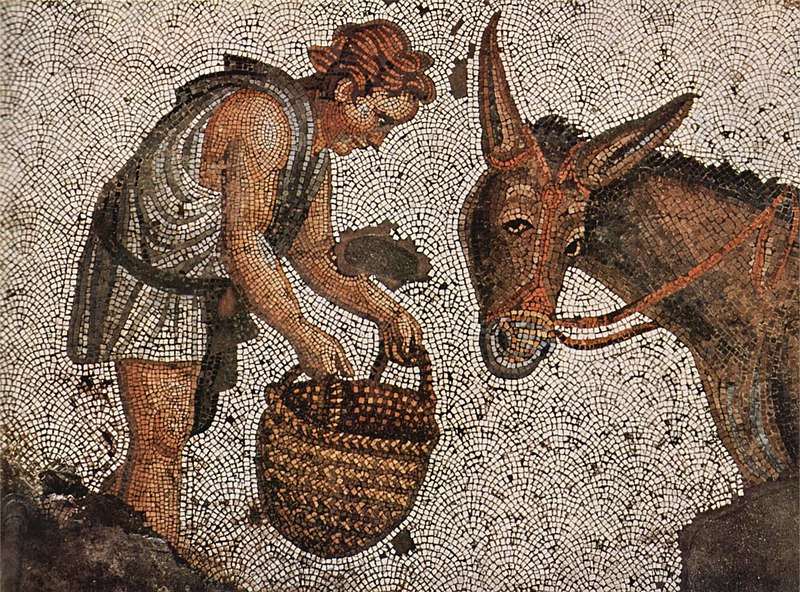
Floor mosaic of a child and a donkey (c. 5th century)
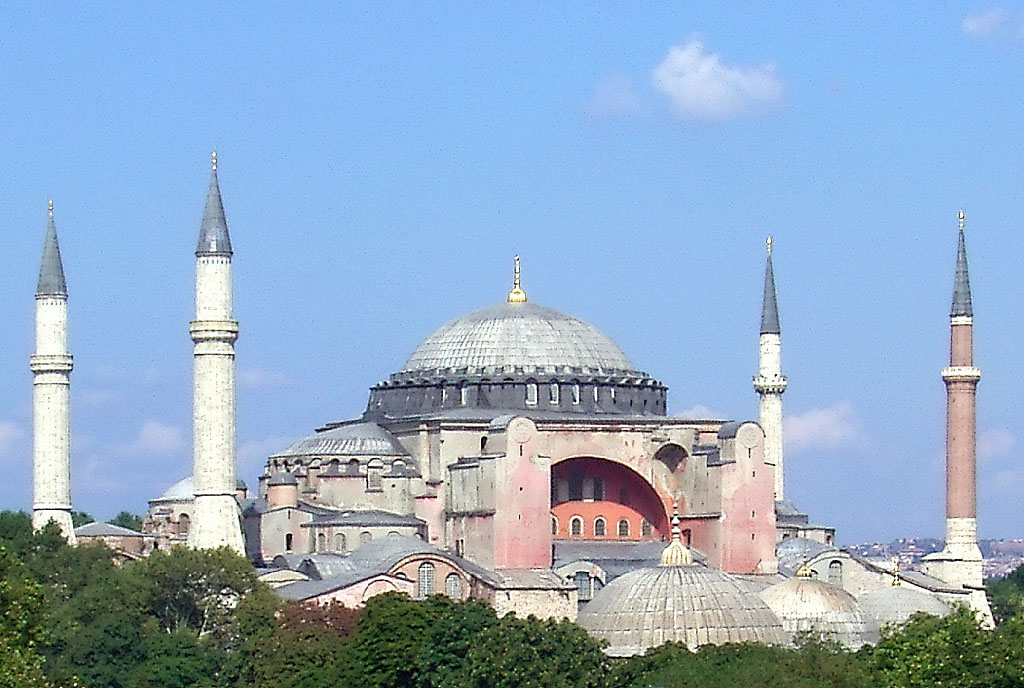
Structure 4 (Link)The only visible structure left from the past. Thousands years old.
Hagia Sophia (
Turkish:
Ayasofya, from the
Greek:
Ἁγία Σοφία, "
Holy Wisdom";
Latin:
Sancta Sophia or
Sancta Sapientia) is a former
patriarchal basilica, later a
mosque, now a
museum in
Istanbul,
Turkey. Famous in particular for its massive
dome, it is considered the epitome of
Byzantine architecture and to have "changed the history of architecture."
[1] It was the largest cathedral in the world for nearly a thousand years, until the completion of the
Seville Cathedral in 1520. The current building was originally constructed as a church between 532 and 537 A.D. on the orders of the
Byzantine Emperor Justinian, and was in fact the third
Church of the Holy Wisdom to occupy the site (the previous two had both been destroyed by riots). It was designed by two architects,
Isidore of Miletus and
Anthemius of Tralles. The Church contained a large collection of
holy relics and featured, among other things, a 15m (49 foot) silver
iconostasis. It was the
patriarchal church of the
Patriarch of Constantinople and the religious focal point of the
Eastern Orthodox Church for nearly one thousand years.
It remained as a mosque until 1935, when it was converted into a museum by the Republic of Turkey.
Exterior view.

Interior view.